
 Frontera Guide
Everyday use
Memory and preferences
What agents remember about you, and how to see and control it.
Agents with memory carry useful context across conversations, so you don't re-explain your role, your formats, or last week's decisions every time.
What gets remembered
Memory is selective by design. The goal is a small set of durable, useful facts, not a transcript of everything you ever said:
- About you: your role, preferences, recurring context. "Prefers tables over prose. Works on the western region."
- About the job: lessons the agent keeps about how to do its own work well.
- Preferences you set: instructions you want every agent to respect, managed in your settings.
Consolidation happens after conversations end: the agent reviews what mattered and files it, rather than hoarding raw history.
Seeing and correcting memory
Memory is governed and visible, not a black box. Open the account menu in the bottom-left corner, choose Memory, and you get the full picture:
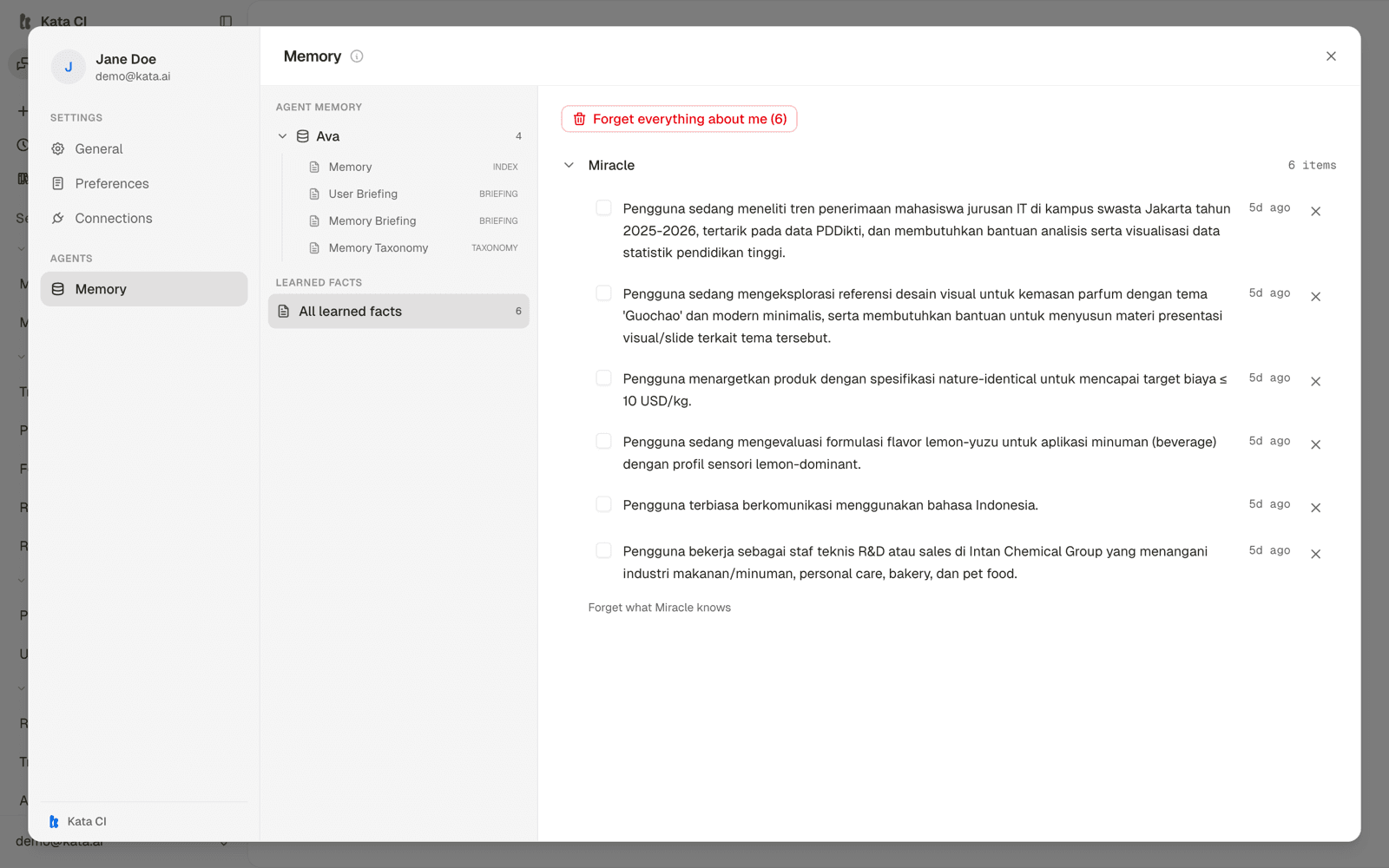
- Agent memory shows each agent's structured memory pages about you, such as a user briefing and its own working taxonomy.
- Learned facts lists the individual things agents have picked up, each with its age. Remove any single fact with its delete button, forget everything one agent knows, or use Forget everything about me to wipe the slate.
- Corrections work in conversation too: "forget that, from now on assume I cover all regions" updates memory going forward.
- Workspace admins can additionally inspect and manage agent memory from the Console.
Memory is not knowledge
Two different things, easy to confuse:
| Memory | Knowledge | |
|---|---|---|
| Contains | Facts about you and the agent's own lessons | Your organization's trusted documents |
| Written by | The agent, from conversations and feedback | Builders, by ingesting sources |
| Scope | Per user and agent | Workspace-wide |
If an agent gives a wrong answer about company policy, the fix is its knowledge, not its memory.